Expiry date inventory management Syria isn’t your restaurant’s topic, but it’s the same problem: orders evaporate between Instagram and WhatsApp when there’s no single screen to hold the day together. Many think the fix is more ads; the truth is operational leakage: split conversations, half-written addresses, and the kitchen starting before the order is actually ready.
7 out of 10 — owners we know run invoicing via Excel and chats, not one system.
Situation
A Damascus grill operation with steady repeat customers and word-of-mouth demand. Daily order channels: Instagram DMs, WhatsApp chats, and quick calls with on-demand drivers. One order spreads across three surfaces and loses critical context.
The frontline responder was fast but tool-less for consolidation. An order would contain a picture, a voice note for add-ons, and a pasted address pulled from an older chat. Under pressure, response time doubled because the team hunted across threads for the last address update, who replied last, and whether the quote was confirmed.
Accounting came later. Evenings were manual attempts to compile a daily Excel summary. Month-end close dragged because invoices didn’t match the floor reality. From our field notes, a small-to-mid operation closing on Excel needs roughly five to ten working days, a window where errors pile up and decisions stall.
The team leaned on three to five separate tools: chats, sheets, a legacy accounting app, and driver messages. Context was fragmented, delivery mirrored that fragmentation, and any one-day absence by a key person created a gap patched with extra calls and manual re-checks.
“Rush hours don’t scare me. What scares me is losing half a day to stitching chats back together.”
In the first session, we focused on ops before tech. We walked the noon peak: how a “hi” turns into a kitchen task, becomes a driver handoff, and lands as a booked amount. We didn’t debate a standard package; we designed one clear track.
Action
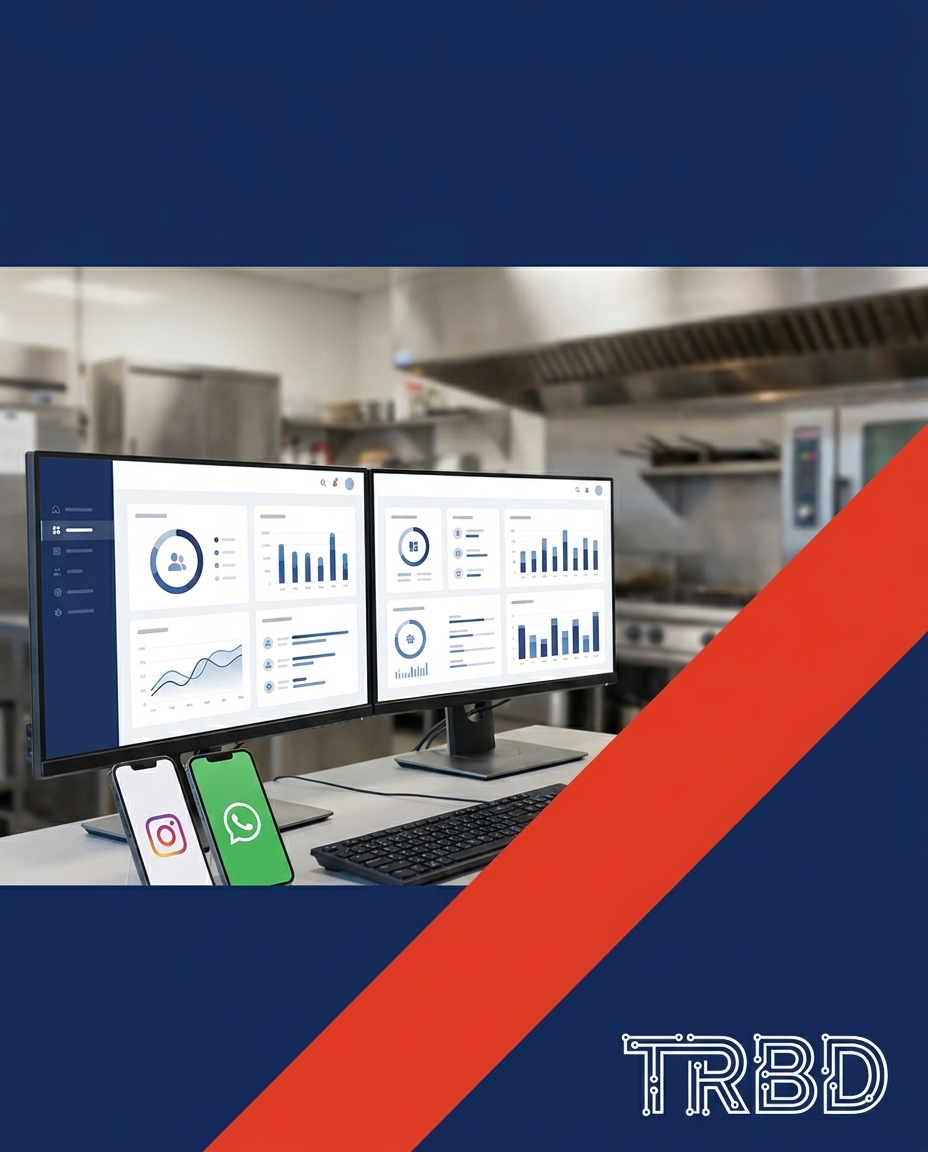
We built a unified web platform under our Web Platforms line, integrating via APIs into the messaging channel, with an operations board wired to the accounting layer. The purpose: one screen to capture orders and convert them into tasks with a clear ID and state.
- Ingest messages: any purchase intent spawns an order card with prefilled fields: name, phone, district, notes.
- One identity: the system generates an internal order ID visible to the whole team. If follow-up messages arrive, the Merge order button ties them in and kills duplicates.
- Confirm before cooking: the default call-to-action became Confirm address instead of Send to kitchen. The system requires validating critical fields (address, phone, sensitive notes) and shows a checkpoint.
- Simplified kitchen view: clear states only—In prep, Ready to handoff, With driver. Each state has sharp actions: Start delivery, Address issue.
- Automated daily accounting: when the driver closes an order, a financial movement gets created and the invoice lands in sales. The structure makes month-end close a formality, not a rebuild.
We followed our usual delivery tempo: first production version in about a month to a month and a half from kickoff. Each step shipped as a small bundle: flow analysis, UX/UI design, full‑stack build, API integration, then a pilot week with heavy observation.
Between a month and a month and a half — a typical window to first ship.
After stabilization, we added a chat nudger to remind staff about pending confirmations, plus a duplicate-thread filter. Adding a module on top of an existing system typically takes two to three weeks because the data model and auth already exist, so you’re shipping features, not plumbing.
Interfaces were Arabic-first—from labels to validations to end-of-day reports. That cuts onboarding time for non-technical hires; most clients see a drop from shadowing for days to under four hours of hands-on training when the UI speaks their language.
We also switched on action logs per order: who edited the address, who pressed Merge order, who approved the invoice. Culture shifted: rare errors got surfaced, and fixes followed evidence, not hunches.
Result
On the kitchen and delivery sides, workload snapped into place: cooks saw only what to cook, service staff handled confirmations and payments, and drivers touched complete addresses. An order became one entity—not three chats.
Month-end was no longer a stitching marathon. From our client base, teams that used to close on Excel in five to ten working days moved to closing in under forty-eight hours within the first quarter after go-live.
Under 48 hours — a full month closed after stabilization, down from a 5–10 day window.
Here’s a compact before/after on operational indicators:
| Metric | Before | After |
|---|---|---|
| Month-end close time | About 5–10 working days | Under 48 hours (approx.) |
| Support tickets per month | About 15–25 in month one | About 2–4 after stabilization |
| Onboarding time for new staff | Days of shadowing (no numeric baseline) | Under 4 hours (approx.) |
| First version time-to-production | No unified system previously | About 1–1.5 months (approx.) |
| Adding a secondary module | Full fresh project (qualitative) | About 2–3 weeks (approx.) |
“For the first time, Instagram and WhatsApp aren’t a burden. It’s one clear track—from first word to final invoice.”
The key shift wasn’t purely technical. The screen made us define “order readiness” before the kitchen got involved. That single decision prevented premature cooking, slashed rework, and lined up the team around one operational truth.
Lessons learned
- Wiring chats together isn’t the goal; making an order a single entity with an ID, confirmation, and state is. Any integration without state control preserves chaos.
- Forcing Confirm address before the kitchen beats any checklist. Smart UI trumps a paper SOP.
- Arabic-first UI accelerates adoption and cuts onboarding to under four hours for non-technical staff, which stabilizes shifts.
- Ship a first version in a month to a month and a half; don’t wait for perfect. Add modules in two to three weeks once you see real gaps.
- Tie accounting to the driver handoff to move month-end from a 5–10 day window to under 48 hours after stabilization.
Why bring up expiry date inventory management Syria in a restaurant story?
Because it’s the same operational backbone: the issue isn’t many channels or SKUs; it’s the absence of one execution screen with clear states. If we can stop losing a meal order across two chats, we can also stop pharmacy stock drift by pinning item state and expiry on one screen. Different sector, same ops logic.
✅ Strengths
- Order as a single entity—from first DM to delivery handoff.
- Role-focused UI for kitchen and service; each sees only what matters.
- Faster onboarding via clear Arabic-first labels and validations.
- Accounting integration that cuts month-end close to under 48 hours post-stabilization.
❌ Constraints to expect
- Month one is ticket-heavy (about 15–25) until rare cases surface and settle.
- Cross-department integrations may need two to three months in larger scopes; don’t expect day-one completeness.
FAQ
Do we need a brand-new mobile app for drivers?
Not necessarily. In this case, a responsive web app was enough. If you later need native features, add a mobile app under our Mobile Apps service as a follow-on module in about two to three weeks once the core stabilizes.
How did you merge Instagram and WhatsApp messages without losing context?
A middleware layer reads the message, creates an order card, and tags every interaction under the same ID. The Merge order action fixes duplicate-thread cases.
What’s the usual launch timeline?
Our typical window is a month to a month and a half to first production. Multi-department, complex integrations can take two to three months.
When do support tickets drop?
Month one tends to be busy (roughly 15–25). They settle to about 2–4 per month for stable clients.
Got a similar case?
If this sounds like your day, let’s spend 15 minutes mapping your current order flow—no commitment. Drop us a “order” on WhatsApp via https://wa.me/905537323153 and we’ll sketch the one screen that holds your day together.