Difference between estimated and actual budget shows up fast when your clinic’s receptionist drowns in calls and WhatsApp, and two appointments collide at rush hour. Patients phone to double-check, every confirmation adds friction, and Thursday ends with a double-booking and a half-hour gap when your chair should be busy.
Three signs the schedule is slipping: patients asking “where’s my turn?”, a slot booked twice because a WhatsApp message went to the wrong chat, and a full hour lost at day’s end reconciling a paper pad with voice notes.
The operational problem
Small clinics run on rhythms: clear peak hours and patients who like to confirm twice. When the only channels are calls or ad-hoc messages, gaps appear: bookings with missing details, no-shows that never cancelled, or a doctor delay that forces a reshuffle.
The cost isn’t just receptionist time. The real pain is the difference between estimated and actual budget of chair time. You planned fifty minutes per patient with fast turnover; reality eats seventy-five because of late confirmations and “where are you now?” calls.
7 out of 10 — business owners we meet actually run basics via Excel and WhatsApp, not a unified system.
Any booking without a clear path creates a new question instead of answering an old one. With each extra question, a clinical note can be missed, a priority case gets misordered, or a “reserve” slot gets hand-written where no one reads it.
3 to 5 tools — the average stack we find: WhatsApp, Excel, an old accounting app, a paper pad, and sometimes a separate POS.
Result: exhausted staff, a doctor jumping room-to-phone-to-room, and late patients because no confirmation reached on time. That’s how the difference between estimated and actual budget widens: a projected full calendar, and actual hours leaking with no return.
Why off‑the‑shelf won’t cut it
Generic “book your visit” apps assume a model clinic: one service type, fixed durations, zero call-backs. Reality disagrees. Things change daily: a doctor at another branch, a walk-in urgent case, an imaging specialist available for a short window.
Even paid plans look great in brochures but won’t fit your call-and-message flow. You’ll fall back to the paper pad because it feels “faster”, and the loop restarts.
- Channels stay fragmented: phone logs in one place, WhatsApp threads elsewhere, no reconciliation.
- Rules are either too loose or too strict: allowing overlaps or blocking critical exceptions.
- Reports are generic: no view of time lost between confirmations or empty-chair minutes.
- Weak integrations: no “quick book” link in your messages, and no Arabic-first confirmations.
5 to 10 days — is what we often see for month-end close when teams run on Excel. The same chaos pattern shows up in scheduling.
The difference between estimated and actual budget in a small clinic
In scheduling, there are two budgets: planned time per service and expected daily volume, and actual time after confirmations, reschedules, and room hops. With split channels, estimates become wishful, and actuals bloat quietly.
Track two lines: receptionist minutes spent chasing and counting, and chair-time lost between patients. Every extra phone minute can mean one less patient in the same shift, even if fees are fixed.
Under 48 hours — after we deploy an integrated system, many clients get their monthly reports within two days instead of a week. The same principle applies to your calendar.
The TRBD fix
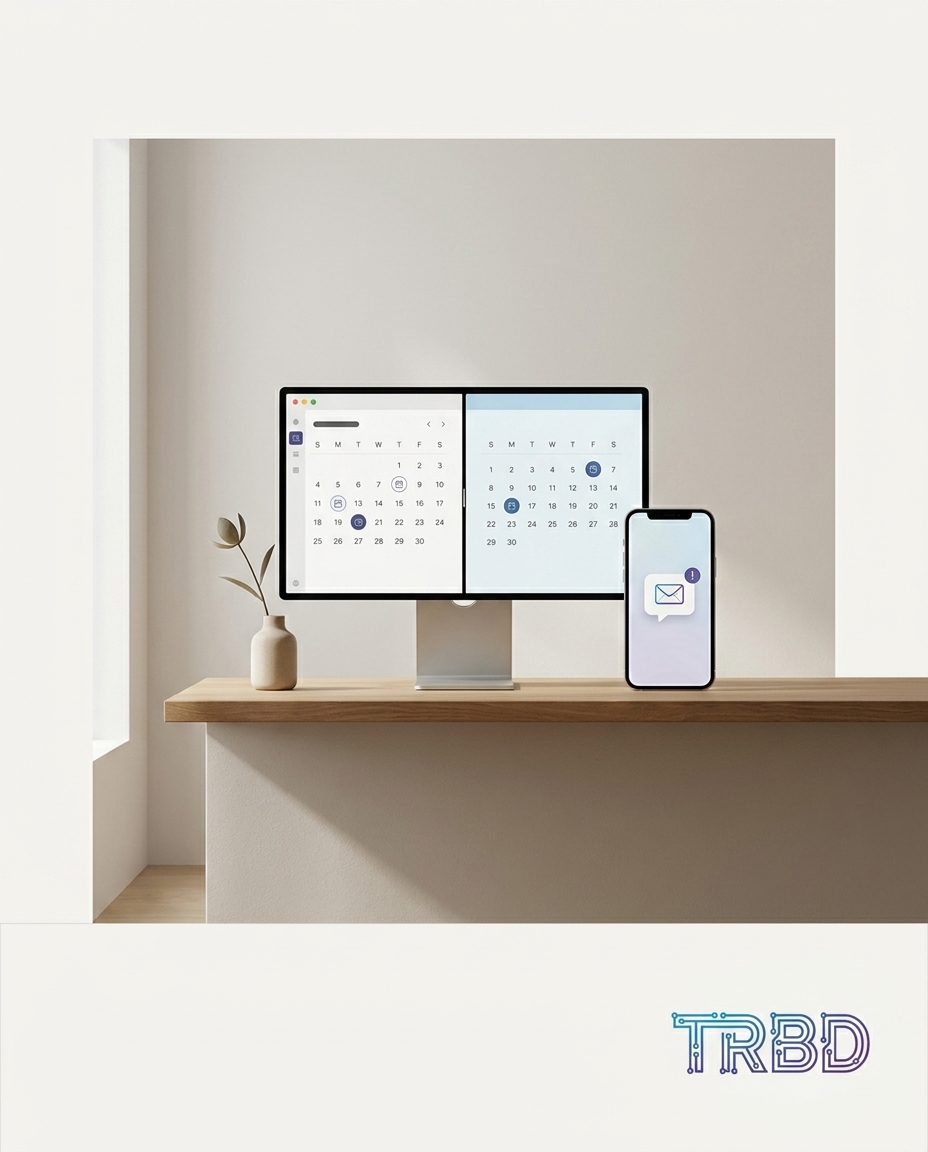
We ship on two coordinated tracks as your case needs: “Web Platform Development” for a central admin and booking panel, and “Mobile Apps” if you want a lightweight app for the receptionist or doctor on the go. One goal: a single booking channel — from a call, from WhatsApp, or from a web form — landing on the same calendar.
Your stack has four practical layers:
- An internal booking screen for the receptionist with “quick patient search” and a one-tap “Quick Book” button, with service, duration, and a short note.
- A public booking link sent by automated WhatsApp message including “Pick a date” and “Confirm” in Arabic-first UI.
- A doctor panel showing “Today view” and “Triage/Move” between rooms.
- Integrations with WhatsApp Business templates and telephony APIs so every missed call creates a “Follow-up task”.
Our project steps are lean and clear:
Flow-mapping session: 90 minutes to detail service types, peak hours, and confirmation policies that fit you.
Clickable prototype: first receptionist-facing UI for UAT in a couple of days once flows are agreed.
Integration and go-live: wire WhatsApp Business templates and telephony APIs, and ship the first production version.
One live week: capture team feedback; tune booking rules, gaps, and auto-messages.
Between one and one-and-a-half months — is our typical path from first session to first production release. Cross-department setups with multiple branches may take two to three months.
Scope includes UX/UI, admin and front-end build, API integrations, deploy, and maintenance. If you have an old accounting app, we add a simple export for visits and invoicing so numbers stay from one source.
| Channel | Before | After |
|---|---|---|
| Phone | scattered paper notes | a missed call creates an automatic follow-up task |
| messages across multiple threads | a unified booking link pipes into the same calendar | |
| Walk-in | names on a pad | create a slot with name and notes in seconds |
15 to 25 tickets — in the first month is normal as users hit edge cases. After that, things usually settle at 2 to 4 tickets monthly.
Why this works on the shop floor
The root problem isn’t a “calendar app”; it’s unifying a single entry point for information. When every booking flows to one calendar, you get a single source of truth. From there, the “obvious” features work: auto-confirm, conflict prevention, and delay alerts.
Arabic-first design matters: clear labels, helpful validation, Arabic reports. That directly shortens onboarding time for non-technical staff.
Under 4 hours — with Arabic-first UI, onboarding a new non-technical employee drops to this kind of window.
Practically, this narrows the difference between estimated and actual budget: dead time shrinks, and estimates align with reality because every move is recorded and confirmed in the moment.
How to start with us
If this sounds like your day, let’s do a short chat and trace your real booking flow with zero fluff. Send “20‑minute assessment” on our team’s WhatsApp at https://wa.me/905537323153 and bring two fresh examples of lost hours.
My take
Every time we find a clinic running on calls and messages with no unified record, we see the same pattern: small daily gaps compounding at month’s end. The estimate–actual gap isn’t a “software choice”; it’s a discipline of a single information path.
Without a single entry point for data, any other automation is decoration on top of chaos.
Off-the-shelf apps treat symptoms: a pretty calendar and a generic reminder. You need to treat the cause: model your specific flow, then build a path that matches it. Once every appointment lands on one calendar regardless of channel, decisions speed up: reschedule here, insert an urgent case there, and close empty-chair gaps before they grow.
From the numbers we see, go-live windows stay reasonable when the path is clear. A first working version in roughly a month changes team behavior; a quarter later, operational visibility is real: which services leak time, where to add a shift, and which offering to pause. That’s when the difference between estimated and actual budget shrinks — because now there’s one trusted ledger, not gut feel and scattered notes.